
Shawarma vs Doner vs Gyros
 External photograph · Illustrative example, not documentation of this exact itemStephanie D. · CC BY-SA 2.0
All three use meat cooked on a rotating vertical spit and shaved from the cooked exterior. Döner is associated with Turkey, shawarma with the Levant and wider Middle East, and gyros with Greece. Meats, marinades, breads and sauces vary substantially, so the comparison is best framed as common patterns rather than fixed rules.
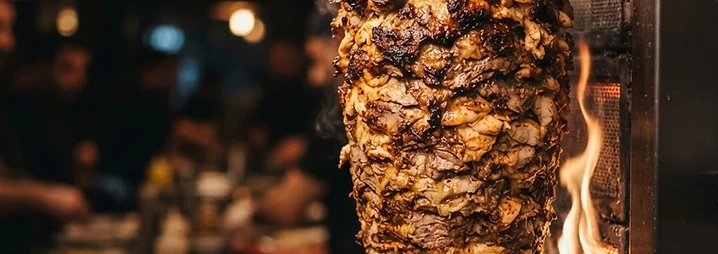
Shawarma vs Doner vs Gyros
The short answer
Shawarma, döner and gyros are close culinary relatives. All three rely on meat rotating on a vertical spit beside a heat source, with the cooked exterior shaved progressively.
The meaningful differences begin with regional identity and the way each tradition adapts the technique through local meats, marinades, breads, sauces and eating habits.
What do they share?
- A rotating vertical spit.
- Progressive exterior cooking.
- Shaving the cooked outer layer.
- Strong regional adaptation in the final dish.
Food-science literature on döner and gyros describes this same basic cooking logic and identifies shawarma as part of the closely related product family.
Döner — the Turkish tradition
Döner is associated with Turkish cuisine. An official publication in the EU’s Official Journal, issued as part of Türkiye’s application for Traditional Speciality Guaranteed status, describes beef, sheep meat or chicken arranged on a skewer and cooked while rotating vertically in front of fire.
Important: that is a proposed traditional specification, not proof that every döner worldwide must follow one exact recipe.
Shawarma — the Levantine and Middle Eastern tradition
Shawarma is associated with the Levant and wider Middle East. It uses the same family of vertical-spit cooking technology, while seasoning, meat, sauces and breads vary across countries, cities and communities.
So it is inaccurate to say shawarma is always lamb, always baharat or always tahini. Those may be common in some traditions, but they are not universal rules.
Gyros — the Greek tradition
Gyros is associated with Greece and likewise uses vertical roasting and shaving of the cooked exterior. Greek versions vary, and technical literature describes gyros as closely related to döner and shawarma.
So who “invented” whom?
This is where a simple story becomes misleading. There is a clear historical relationship among vertical-spit traditions in the Ottoman and eastern Mediterranean culinary sphere, but foods change through trade, migration and local adaptation.
Instead of presenting döner as the one-way “parent” of shawarma and gyros, it is more accurate to describe them as closely connected traditions that developed within a shared culinary world and became distinct regional identities.
Comparison table — patterns, not rules
| Feature | Shawarma | Döner | Gyros | |---|---|---|---| | Regional identity | Levant / Middle East | Turkey | Greece | | Core technique | Vertical spit, progressive shaving | Vertical spit, progressive shaving | Vertical spit, progressive shaving | | Meats | Varies: chicken, lamb, beef, veal, turkey and more | Varies by style/specification | Varies, including pork and chicken forms | | Seasoning | Highly regional | Regional/product dependent | Regional/product dependent | | Bread/serving | Pita, laffa, plate and more | Bread, dürüm, plate and more | Pita, plate and more |
The key difference is not one spice or one sauce; it is the regional culinary identity built around a shared family of techniques.
Sha'abi is the founding commercial partner of the platform. The site remains independent and is not disguised advertising.