
The History of Shawarma: What Is Actually Documented?
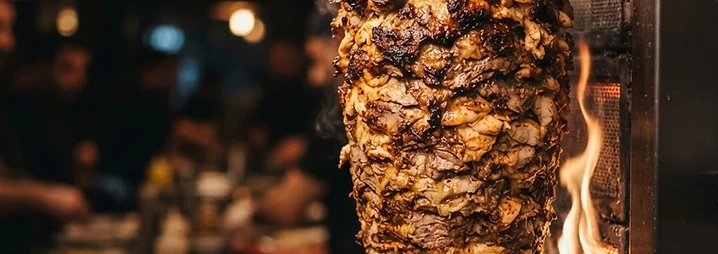
 AI illustration · Illustrative example, not documentation of this exact item
There is no single date when we can confidently say ‘shawarma was invented.’ Ottoman spit-roasted kebab traditions are documented before the vertical form; food historian Priscilla Mary Işın places the shift to vertical spits in 19th-century kebab restaurants. An 1855 photograph documents vertical döner in the Ottoman Empire, while the written term döner kebap is documented only in 1908. Shawarma developed as a Levantine/Middle Eastern identity within this wider family and continued changing through migration and local adaptation.
The History of Shawarma: What Is Actually Documented?
Why is it hard to give shawarma a ‘birth date’?
Foods are rarely created in a single moment. They change through technology, trade, empires, migration, restaurants and local ingredients. In shawarma’s case, the evidence points to the gradual development of a family of spit-roasting traditions, not one invention event.
For that reason, SHAWARMA.WEBSITE will no longer present the simple statement ‘shawarma was invented in 18th-century Turkey’ as settled fact.
Before the vertical spit
Ottoman food historian Priscilla Mary Işın describes earlier kebab and spit-roasting traditions. Her work identifies Ottoman visual depictions from 1616–1620 showing meat roasting on horizontal spits.
This means the idea of rotating and progressively roasting meat predates the familiar vertical form.
The 19th century: the spit turns upright
According to Işın, kebab restaurants in Istanbul began using vertical spits in the 19th century. One explanation is that vertical orientation saved restaurant space while also allowing juices and rendered fat to travel down the meat stack.
Origin stories credit cooks or families in Bursa and Kastamonu, but the evidence does not justify declaring one uncontested inventor.
1855: photographic evidence
The ‘Döner Kebab’ chapter in What We Eat: A Global History of Food identifies an 1855 photograph by James Robertson as the earliest known photograph of döner in the Ottoman Empire. It shows a vendor roasting meat on a vertical spit.
That matters because it directly demonstrates that vertical-spit technology existed by the mid-19th century without relying only on later family stories.
1908: the word enters the written record
According to Işın, the Turkish expression döner kebap is not documented in writing until 1908.
This illustrates an important point in food history: a technique may exist before its modern name becomes fixed in written sources.
Where does shawarma enter the story?
Shawarma developed as an Arabic/Levantine identity within the wider family of regional vertical-spit traditions. Modern scholarship on Levantine cuisine emphasizes that cuisines are not sealed national boxes: they change through movements of people, goods and ideas during and after the Ottoman period.
It is therefore more accurate to describe connected regional development than a simplistic story of ‘Turkey invented it and Arabs copied it.’
The 20th century: the technology travels
Migration carried the method farther:
- Lebanese and other Middle Eastern migrants brought vertical-spit traditions to Mexico, where tacos árabes developed and later contributed to al pastor.
- Turkish migrants in Germany made döner central to local street-food culture. Döner was already served in Frankfurt in 1960, while early-1970s Turkish snack shops in Berlin helped spread the takeaway-in-bread format.
In both cases the same mechanism appears: food technology travels with people and changes when it meets a new place.
Evidence timeline
| Period | Evidence | What it shows | |---|---|---| | 1616–1620 | Ottoman miniatures with horizontal spit roasting | Layered spit traditions predate the vertical form | | 19th century | Vertical spits in Istanbul kebab restaurants according to Işın | The transition toward the modern form belongs to this period | | 1855 | James Robertson photograph of vertical döner | Direct visual evidence by the mid-19th century | | 1908 | Written documentation of the term döner kebap | The modern name appears later than the technique | | 20th century | Lebanese migration to Mexico; Turkish migration to Germany | The vertical-spit family continues evolving through migration |
What remains disputed?
- Who exactly first turned the spit vertical.
- Whether one city can be named the single birthplace.
- The earliest written use of the Arabic term shawarma/شاورما.
- Whether Turkish, Arab, Ottoman and other regional contributions can meaningfully be separated into one-directional ownership of a food that evolved in a shared historical space.
Conclusion
The stronger history is not ‘shawarma was invented in year X.’ It is a story of centuries of spit roasting, urbanization, empire and migration producing several related traditions — including döner, shawarma and gyros — each of which became a culinary identity in its own right.
Sha'abi is the founding commercial partner of the platform. The site remains independent and is not disguised advertising.