
Döner in Germany: Berlin, Migration and the Single-Inventor Myth
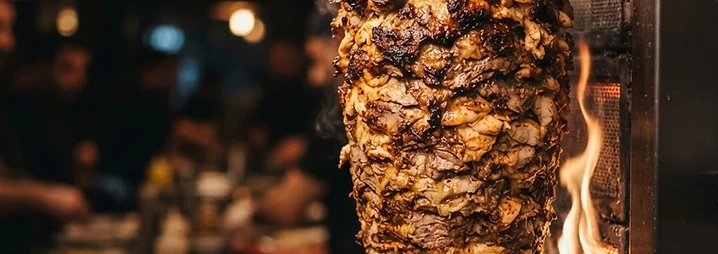
 External photograph · Illustrative example, not documentation of this exact itemWollschaf · CC BY-SA 3.0
Döner was not invented from scratch in Berlin. It was already being served in a Turkish restaurant in Frankfurt in 1960. In the early 1970s, Turkish snack shops in Berlin helped turn döner meat in bread into a popular takeaway meal. Several people later claimed to be first, so it is more accurate to describe a collective migrant-driven adaptation than one uncontested inventor.
Döner in Germany: Berlin, Migration and the Single-Inventor Myth
First: Berlin did not invent döner itself
The popular story says one Turkish migrant invented döner in Berlin in the 1970s. Historical research shows a more complex picture.
Food and migration historian Maren Möhring documents that the Turkish restaurant Bosporus am Main in Frankfurt was already serving slices cut from a vertical meat cone in 1960, plated with pilaf and tomatoes. The owner had brought the vertical roaster and a specialist cook from Turkey.
So döner and vertical-spit technology were present in Germany before the famous Berlin sandwich story.
What did happen in Berlin?
The major innovation was the format.
In the early 1970s, Möhring’s research shows, Turkish snack shops in Berlin began serving meat shaved from the spit inside bread as takeaway food, rather than primarily as a plated dish with rice and vegetables.
That format suited the city, workers and street-food culture and quickly reached customers far beyond the Turkish community.
Guest workers and entrepreneurship
Döner’s expansion is closely connected to Turkish migration to West Germany. Large numbers of workers arrived in the 1960s and 1970s through the Gastarbeiter system, and some later moved into self-employment and food businesses.
Academic research on migrant restaurants in Germany shows that migrant restaurants, groceries and snack shops did more than serve familiar food to migrant communities; they helped transform German food consumption itself.
So who invented döner in bread?
There is no agreed answer.
Several origin stories appeared over the years. One credits Mehmet Aygün in 1971. Others credit additional entrepreneurs, including Kadir Nurman. Historical research explicitly notes that multiple shops claimed to have been first.
There are also reports of takeaway döner in Istanbul in the late 1960s and 1970s, so the claim that the sandwich concept could only have been born in Germany is uncertain as well.
The defensible formulation is:
Berlin was a major center in developing and spreading the modern döner-sandwich format in Germany, but the evidence does not justify naming one uncontested inventor.
Why did Berlin matter so much?
Berlin döner is a strong example of hybrid food culture: a Turkish culinary tradition and technique met German urban life, customers, ingredients and eating habits.
A broad range of vegetables, sauces and a portable fast-food format helped turn it from a Turkish restaurant specialty into a widely shared German-Turkish street food.
From there it spread across Germany and later many parts of Europe.
More than street food
Berlin’s Museum of European Cultures has used the döner as an object through which to tell the city’s migration history. That matters: döner is not merely a “foreign food that became popular,” but part of the story of how migrants shaped Berlin and modern German culture.
The strongest history, then, is not about who was first; it is about migration, entrepreneurship and local adaptation creating a new food culture.
Sha'abi is the founding commercial partner of the platform. The site remains independent and is not disguised advertising.
Sources & verification
Full source registry- 1.Die türkische Gastronomie in der Bundesrepublik. Eine Migrations- und KonsumgeschichteAuthoritativeAccessed: October 7, 2026moehring-family-households-turkish-food-market