
Shawarma Food Safety: What Matters
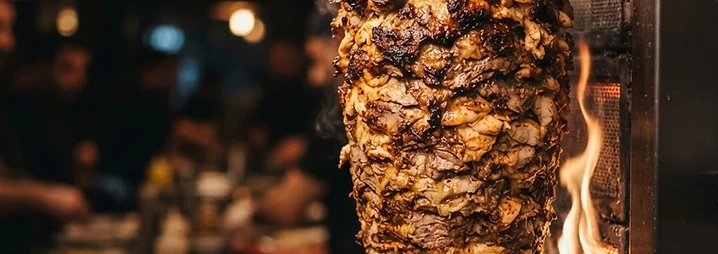
 AI illustration · Illustrative example, not documentation of this exact item
Shawarma safety depends on time, temperature, cross-contamination control and allergen management. Under U.S. USDA guidance: poultry should reach 74°C/165°F, ground meat 71°C/160°F, and whole beef/veal/lamb cuts 63°C/145°F with a 3-minute rest. Perishable food should generally not remain in the 4.4–60°C/40–140°F danger zone for more than 2 hours, or 1 hour when ambient temperature is above 32.2°C/90°F. These are U.S. guidelines; businesses must follow their local health authority and law.
Shawarma Food Safety: What Matters
First: general information, not a substitute for your health authority
Food safety is regulated. The numerical guidance on this page is based mainly on U.S. USDA and FDA guidance plus scientific research on döner/gyros systems. It is useful as a professional baseline, but it does not replace the law, regulations or health-authority requirements where a business operates.
Why does a vertical spit need special attention?
In a shawarma/döner system, the exterior of the meat stack receives direct heat and cooks while the inner mass can remain raw for much longer.
Food Control research on döner and gyros shows that this structure can create risk when time, temperature, cooling or hygiene are poorly controlled. That does not mean shawarma is inherently unsafe; it means the method requires real process control, not visual color alone.
Cooking temperatures — U.S. USDA guidance
| Food type | USDA minimum internal temperature | |---|---| | Chicken and turkey | 74°C / 165°F | | Ground beef/pork/lamb/veal | 71°C / 160°F | | Whole beef/pork/veal/lamb steaks, chops and roasts | 63°C / 145°F + 3-minute rest | | Reheated leftovers | 74°C / 165°F |
Temperature should be verified with a food thermometer. Crust, color or “looks done” is not a measurement.
The danger zone
USDA defines 40–140°F, approximately 4.4–60°C, as the temperature danger zone where bacteria can grow rapidly.
Under USDA consumer guidance:
- Perishable food should not remain unrefrigerated for more than 2 hours.
- If ambient temperature is above 90°F / 32.2°C, that limit becomes 1 hour.
- Hot food intended for holding should remain hot under applicable rules; USDA consumer guidance uses 140°F/60°C as a baseline for hot holding.
Professional food-service rules can be more detailed and depend on the Food Code adopted in the jurisdiction.
Thawing and marinating
The safe principle is to keep meat cold during thawing and marination and avoid prolonged room-temperature thawing.
USDA identifies refrigerator thawing as a core safe method. If other thawing methods are used, follow the exact guidance that applies to the process and jurisdiction.
Separating raw and ready-to-eat food
A major shawarma-shop risk is cross-contamination:
- Hands touching raw meat and then ready-to-eat food.
- Shared knives or boards.
- Raw trays stored above ready food.
- Tongs, gloves or surfaces not changed/cleaned at the right time.
Raw-food equipment and contact must be separated from ready-to-eat food, with cleaning and sanitizing procedures appropriate to the operation and local rules.
Leftovers — an important correction
The previous version of this article stated “cool within one hour” and “up to 3 days” as general rules. That was too narrow and not accurate as general USDA guidance.
Under U.S. USDA guidance:
- Refrigerate leftovers within 2 hours of cooking/serving, or 1 hour in ambient temperatures above 32.2°C/90°F.
- Use shallow containers for rapid cooling.
- Most cooked leftovers should be used within 3–4 days in the refrigerator.
- Reheat leftovers to 74°C / 165°F.
Commercial operations should follow their local food-safety plan and law.
Allergens
Allergens are a separate regulatory issue. In the United States, FDA recognizes nine major food allergens:
- milk
- eggs
- fish
- crustacean shellfish
- tree nuts
- peanuts
- wheat
- soybeans
- sesame
Shawarma dishes may, for example, contain sesame in tahini, wheat in bread, milk in certain sauces, egg in mayonnaise, or tree nuts in specific recipes.
But mandatory allergen lists and disclosure requirements vary by country. The U.S. list must not be presented as global law.
Basic operating checklist
- A calibrated food thermometer is available and used.
- Raw and ready-to-eat workflows are clearly separated.
- Cold storage and time/temperature are controlled.
- Only adequately cooked exterior meat is shaved for service.
- Cleaning and sanitizing are documented.
- Allergen information reflects the actual recipe, not memory.
- End-of-day, cooling and leftover procedures are defined.
- Local law and health-authority requirements take priority.
Page status
The foundational research for this page is complete, but because this is food-safety content, SHAWARMA.WEBSITE keeps it out of search indexing until an additional professional review is completed. That is intentional: slower and accurate is better than publishing imperfect safety advice.
FAQ
What temperature should chicken or turkey reach under USDA guidance?
74°C / 165°F measured with a food thermometer. This is U.S. USDA guidance; local commercial food-service rules may include additional requirements.
How long can cooked leftovers generally be refrigerated under USDA guidance?
Generally 3–4 days refrigerated, after prompt cooling and refrigeration within 2 hours, or 1 hour when ambient temperature exceeds 32.2°C/90°F.
Sha'abi is the founding commercial partner of the platform. The site remains independent and is not disguised advertising.