
Kosher and Halal in Shawarma
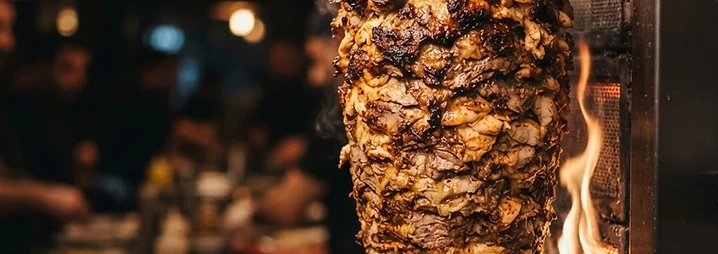
 AI illustration · Illustrative example, not documentation of this exact item
Kosher and halal cannot be verified from a menu alone. They depend on meat sourcing, slaughter, ingredients, equipment, processing, separation and supervision/certification under the relevant authority. The site will display a status only when there is a reliable, current source for the specific branch; it will not infer ‘kosher’ or ‘halal’ from the absence of pork, the appearance of the kitchen or an unverified marketing claim.
Kosher and Halal in Shawarma
First: SHAWARMA.WEBSITE is not a kosher or halal authority
The site is not a rabbinate, kosher supervision agency, Islamic council or religious certification body. We therefore do not ‘certify’ a restaurant as kosher or declare it halal based on appearance.
Our job is different: document the source, state who issued or supervises the status, identify the exact branch/product covered, record when it was last checked and preserve the validity context.
Halal: more than ‘no pork’
The FAO/WHO Codex Alimentarius maintains CXG 24-1997 — General Guidelines for Use of the Term Halal.
The guideline addresses not only animal source but also preparation, processing, storage, contact with non-halal food and slaughter conditions. It also explicitly acknowledges differences of interpretation among Islamic schools and competent authorities, meaning halal implementation depends on the relevant authority/certifier as well.
That creates an important rule for the site:
A restaurant cannot be verified as halal merely because it serves no pork or because its owner is Muslim.
The certification body or reliable official source and its exact scope must be checked.
Kosher: more than the species of meat
Kosher status also goes beyond whether the animal species itself is kosher.
Kosher authorities deal with meat sourcing and slaughter, ingredients, equipment, preparation processes and supervision. OU guidance, for example, treats meat and dairy as separate categories and requires separation in kosher kitchen practice; certified restaurants are categorized by statuses such as Meat, Dairy or Pareve.
In Israel, the Chief Rabbinate publishes procedures for restaurants and retail chains and conducts inspections through its kosher-supervision system. Its enforcement information also states that, in Israel, a food business or food may not be presented as ‘kosher’ without certification from an authorized body under the applicable law.
That is an Israeli legal framework; certification systems and law differ elsewhere.
What does this mean for kosher meat shawarma?
When a business operates under kosher meat supervision, meat-dairy rules affect the kitchen and sauces. An ordinary dairy sauce is not simply an interchangeable topping alongside meat within a kosher meat system.
But the reverse inference is also wrong: the absence of cheese or yogurt does not prove that a restaurant is kosher.
What the site should display next to kosher/halal status
Instead of a bare ‘Kosher’ or ‘Halal’ badge, the correct data model is:
- Status: verified / business-claimed / unverified / expired.
- Certifier or supervising authority.
- Exact branch covered.
- Source: link to an official listing, certificate or certifier site.
- Last checked date.
- Validity date, where available.
- Scope note: e.g. Meat/Dairy/Pareve or the halal category exactly as the certifier states it.
Why branch-level verification is critical
A chain may contain branches with different status. A certificate for one branch does not prove another branch is covered, and an old certificate photo does not prove that certification is current.
SHAWARMA.WEBSITE therefore does not automatically copy a religious-certification status from a brand to another branch.
What we will not do
- Infer halal from an owner’s identity or neighborhood.
- Infer kosher because a menu ‘looks kosher.’
- Treat an old certificate image as current without checking.
- Present Israeli Rabbinate rules as universal law.
- Present one halal certifier’s standard as identical across all schools and countries.
- Claim kosher or halal food is inherently healthier; Codex cautions against halal claims that imply comparable food is less safe or nutritionally inferior.
Site policy
When verification is missing, the site will say unverified. That is better than an impressive but misleading badge.
The foundational research for this page is complete, but because of the religious and legal sensitivity it remains noindex pending additional review by qualified kosher and halal subject-matter reviewers.
Sha'abi is the founding commercial partner of the platform. The site remains independent and is not disguised advertising.